

A few days ago, as the world watched, Denmark midfielder Christian Eriksen’s life was saved by CPR and a defibrillator. He had collapsed on the field during his team’s Euro 2021 clash with Finland. Those present are sure that he would not have survived without the first aid given to him by medical professionals.
“[Eriksen] was gone. We did cardiac resuscitation, it was a cardiac arrest.
How close were we to losing him? I don’t know”
– Denmark’s team doctor Morten Boesen.
Fortunately, Eriksen is well on the way to recovery, but he is alive because those around him knew about CPR and defibrillation using an AED. The event was a shock to the world, and a reminder of the lifesaving difference first aid training can make.
Cardiac resuscitation (CPR), AEDs and how they saved Christian Eriksen
Cardiac or cardiopulmonary resuscitation (CPR), saves the lives of hundreds of people who suffer from critical heart issues every day, and increasingly available automatic defibrillators (AEDS) could save many more. Knowing these techniques and using them immediately can mean the difference between life and death, as in the case of Christian Eriksen. Fortunately, it is relatively simple compared to many life-saving medical practices, so the lifesavers are often normal people like you and me.
When a person’s heart stops, or fails to beat as it should, CPR is the application of regular jolts of pressure to help jump-start it again, not unlike pushing a stalled car to restart the engine. If a defibrillator (AED) is available, along with an extra person to get it out, this should be used as well to restore the casualty’s breathing as explained further into the article.
How to perform CPR.
Anyone can give CPR to a person in danger, but it must be delivered immediately after the heart has stopped or ceased to beat regularly. Seconds count.
- If you discover someone who is unconscious and likely to be suffering from heart trauma, call 999 for an ambulance immediately and ask the operator if an AED is close. If one is nearby send someone to get it while you perform CPR. If no one else is available, leave the AED and begin CPR.
– - Remember DR ABC Check danger, response, airway, breathing and circulation (ABC) quickly but carefully.
- Danger – Before approaching the casualty, check there is no danger to you or further danger to them. Beware of electricity in particular.
- Response – Calmly introduce yourself and ask questions such as “What has happened?” and “Can you open your eyes?” to establish if the casualty is responsive. If they do not respond to this, kneel next to them and gently shake their shoulders while repeating the questions. If the casualty still does not respond, continue.
- Airway – After confirming the casualty is non-responsive, tilt their head back to open their airway. Place a hand on their forehead, and 2 fingers on the tip of the chin then slowly tilt the head using gentle pressure.
- Breathing – Check the chest for movement and their mouth and nose for breathing sounds. To confirm, place your cheek several inches from their lips to try and feel their breath for 10 seconds. If the casualty isn’t breathing normally, begin CPR as below, even if you do hear sudden and irregular gasps for breath.
- Circulation – Begin CPR to restore normal circulation.
–
- Put the heel of one hand on the breastbone of the casualty, in the middle of their chest. Place the other hand on top of the first and interlock the fingers
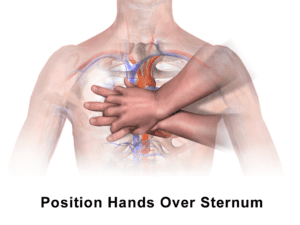 of both hands.
– - Position your shoulders directly over your hands, bearing down on the casualty.
– - Use the weight of your body, not just the strength of your arms, to press straight down 2 to 3 inches on their chest.
– - Release the compression, keeping your hands against the chest with no pressure and allow the chest to return to its original position.
– - Repeat these compressions at a rate of 100 to 120 times a minute (2 per second) until the patient shows signs of life, until medical help arrives or until you cannot physically continue.
– - *Optional* If you are happy to perform rescue breaths, you may deliver 2 for every 30 chest compressions. Pinch the nose and tilt the head back as outlined in the airway section above, then make a full seal with your mouth over theirs and exhale steadily and firmly into their mouth for around 1 second. Check that their chest rises as you do so. Continue these cycles of 30 compressions and 2 breaths.
For reference, Stayin’ Alive by the Bee Gees contains just over 100 beats per minute – one for each compression to be given.
Remember, if a defibrillator is present and someone is available to get it, set this up as CPR is delivered and use it when ready as below.
How to use a defibrillator (AED)
Important: Do not let retrieving a defibrillator hold up the delivery of CPR. Start compressions immediately.
Even if you plan to use a defibrillator, begin CPR immediately. If you are on your own with a casualty, do not stop CPR or wait to get out an AED. If others are available, have them prepare the AED while you carry out CPR or vice-versa.
Most defibrillators have a set of simple instructions. These should be followed if possible. This is a general guide that will enable you to understand the general use of most of them. For more information, see the individual defibrillator’s instructions or consider taking a course.
- Press the large green button and follow the instructions provided.

– - Peel off the large sticky pads and attach them to the casualty’s skin on either side of the chest. Most AEDs will have pictures to follow.
– - Stop CPR so that the defibrillator can accurately assess the casualty’s heart rhythm and determine whether a shock is needed.
– - Automatic defibrillators will shock the patient, while others will tell you to press a button to do so. Do not touch the patient while they are being shocked.
– - The unit will let you know when the shock has been delivered and whether you should restart CPR.
– - Continue CPR until the patient shows signs of recovery or the defibrillator tells you to stop again.
You can save lives with cardiac massage (CPR) and an AED
While Christian Eriksen owes his life to the quick thinking and expertise of medical professionals, anyone can save lives in similar situations where professional help isn’t available.
If you want to learn more about saving lives using CPR, AEDs and other methods, our course in Basic Life Support and the use of an AED will show you all you need to know. Just email us to learn more and book a course.
CPR and safe use of AEDs are central parts of all our first aid courses. You can learn more about all our courses and book them here.


Recent Comments